
Sustainability
Our sustainability initiatives
Ensuring sustainable catering practices
We work alongside our on-site catering partner Green & Fortune to ensure sustainable catering practices. As part of this, we:
- Plan food requirements carefully to avoid unnecessary waste.
- Plan meals using seasonal local produce wherever possible.
- Minimise the use of individually packaged food/drink items – for example, by providing milk or cream in jugs rather than individual plastic cartons, and use reusable crockery, glassware and cutlery.
- Bottle our own water on site, thus reducing transport emissions.
Evolving our catering offerings
Our team are continually evolving our offering, taking inspiration from industry developments whilst maintaining our focus on good quality, honest food. Our chefs can also cater for special dietary requirements, including vegan, vegetarian and gluten-free, and even create bespoke dishes and menus just for your guests.
Wherever we can, we use quality and independently sourced British suppliers to ensure the best possible ingredients. Supplier relationships are important to us as this enables us to deliver the best quality product we can for your event. For more information on our catering offerings or bespoke menus, please reach out to our sales team.

Reducing our environmental impact
Our environmental policy involves…
- Monitoring our energy use and consumption.
- Reducing our water consumption.
- Reducing waste wherever possible.
- Monitoring and working to reduce travel emissions undertaken for business purposes.
- Regularly reviewing and verifying the effectiveness of our environmental management goals and systems through Ecosmart, whilst also ensuring that we comply fully with environmental legislation.

Promoting environmental best practices
Wherever possible, we encourage our clients and visitors to protect the environment, including:
- Encouraging responsible procurement practices wherever possible, such as using local suppliers, recycled materials, biodegradable chemicals and purchasing fairly traded products.
- Providing sustainability information and support to all our staff, so that all staff exercise their environmental responsibility and contribute to good sustainability practice.
- Encouraging our clients and visitors to produce events that are environmentally sensitive, with procedures in place to minimise noise and disturbance to neighbours.
- Promoting environmental best practice to our service partners, encouraging a shared responsibility to protecting the environment.

Choosing a green venue
Our checklist for choosing a greener venue includes:
- Choose a venue that has good access via public transport for disabled people.
- Ask potential venues for their in-house environmental policy.
- Choose a venue interested in sustainability issues and let them know that is why you chose them.
- Consider venues offering in-house technical equipment and support (e.g. staging, audio-visual kit) to reduce equipment transportation.
- Consider video conferencing and/or recording your event for wider access via the internet.

Reducing carbon emissions
To reduce carbon emissions for your event, here are some measures we suggest taking:
- Take measures to reduce CO2 emissions from delegates travelling to the venue, i.e. provide information about local public transport (with pedestrian routes) and encourage its use. Where appropriate, consider promoting car sharing also, e.g. by circulating attendee lists in advance.
- Minimise unnecessary lighting, heating, or air-conditioning to offset CO2 emissions arising from the event.
Reducing waste pre-event
To reduce waste pre-event, here are some of the measures we’d recommend taking:
- Use websites and mailing lists to promote your event.
- Use double-sided printing for promotional materials and hand-outs and use recycled paper where possible.
- Use portable display materials that can easily be transported by an attendee and reused.
- Seek naturally lit meeting and exhibition areas.
- Format any hand-outs to minimise the amount of paper used.
- Where possible, write material in a re-usable format – so make content general rather than event specific.
- Minimise the length of your registration form or use electronic registration where possible, and publish your event itinerary online.
- Ask your venue to recycle paper and cardboard waste, and to provide suitable recycling bins.
- Make your own note pads from scrap paper.
Reducing waste pre and post-event
Below are some of the measures we’d recommend taking to reduce waste pre- and post-event:
- If you are providing delegate packs, choose reusable folders and give these to delegates when they register on arrival instead of beforehand, to avoid duplication.
- Avoid mass distribution of hand-outs – allow attendees to download copies from the internet.
- Ensure your presenters are aware of electronic presentation facilities and that their presentation will be distributed electronically after the event.
- Provide re-usable name badges and remember to collect them at the end of the event.
- Minimise use of accessories that are harmful to the environment, e.g. plastic leaflet wallets.
- Feature your event name and date on a holding slide rather than creating single-use stage set graphics.
- Minimise use of high-wattage stage lighting.
- Promote energy and water efficiency to participants – e.g. encourage them to switch off lights when rooms are not in use.
- Use dry-erase marker boards rather than paper in workshop presentations.
- Request that any unused items be collected for use at another event.
- If not issued at the event, send feedback questionnaires to your delegates or venue by email.
Greengage Sustainability Awards
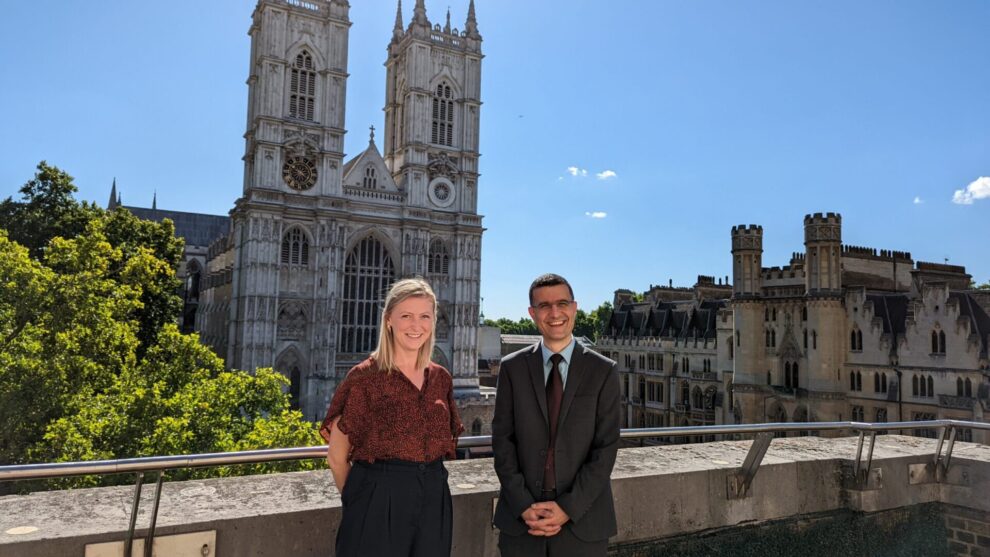
At Central Hall Westminster, sustainability is integral to our supply chain engagement. We work closely with our four key service partners, caterers Green & Fortune, cleaning partners Atlas, Trojan Security, and AV partners White Light, to ensure responsible procurement, waste management, and energy efficiency.
One major initiative has been doubling our waste disposal streams from 12 to 24, achieving zero landfill waste.
There are several ways we’ve implemented this, including…
- Supplier engagement meetings.
- Enhanced on-site waste separation.
- Our AV partner White Light has incorporated energy-efficient AV equipment and minimised transport emissions through pre-built event setups.
- Our catering partner Green & Fortune has transformed its supply chain by reducing food miles, prioritising seasonal British ingredients, and eliminating single-use plastics in its packaging.
- Our cleaning partner, Atlas, has shifted to 100% renewable energy and has introduced electric charging points to reduce transport emissions.
- Trojan Security are encouraging staff to use public transport, recycle ink cartridges and reduce paper use by transitioning to digital processes.
Measurable impact, meaningful change
Through implementing these sustainability initiatives, Central Hall Westminster have achieved a 100% diversion of waste from landfill, expanding disposal streams and strengthening partnerships with waste management providers.
We’ve achieved the following:
- Cut 82,017kg of CO2 via recycling, equalling 63 trees.
- Cut 13,071kg of CO2 by diverting waste from landfill, equalling 214,613 TV hours.
- Installed 2,932 LED light fittings, significantly reducing our energy consumption by 83%.
- White Light has integrated low-power AV solutions to support our carbon reduction targets.
- Replaced our gas boiler, resulting in a four-tonne reduction in carbon emissions.
- Trojan Security’s transition to hybrid and electric fleet vehicles has contributed to emissions reductions.
- Chemical-free cleaning has been introduced, replacing 11 traditional cleaning chemicals with a sustainable alternative.
- Food waste has been tackled through Green & Fortune’s recipe management system and partnerships with Too Good To Go, saving 487 meals in the last 12 months and avoiding 1.31 tonnes of CO2e.
We have been monitoring these measurable successes through supplier sustainability reports, waste data analysis, and ongoing environmental audits. This ensures continuous progress towards our set collective goals to reach Net Zero by 2050, with a milestone goal of 2030.
Frequently asked questions
What sustainability certifications does Central Hall Westminster hold?
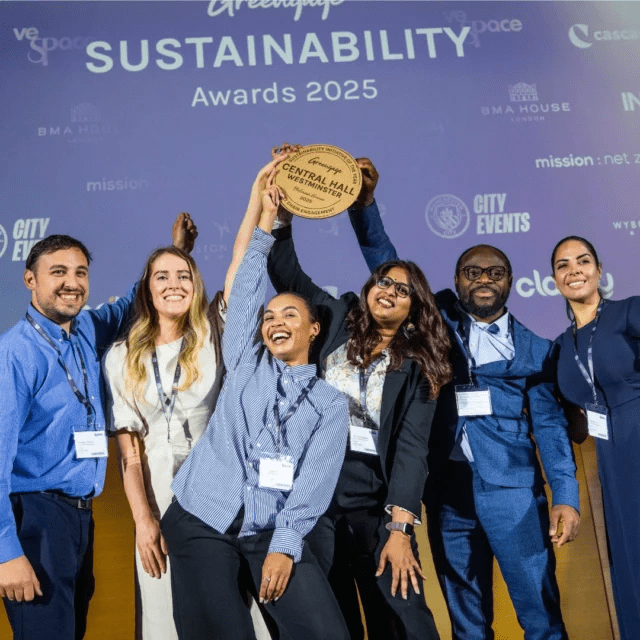
We hold a Platinum Greengage ECOsmart venues accreditation and were recently awarded ‘Supply Chain Engagement Initiative of the Year’ at the Greengage Sustainability Awards. We are also platinum certified in sustainable initiatives with Westminster City Council.
Are sustainable catering options available?
Sustainability is high on our catering agenda; we reduce food miles as much as we can, our menus embrace seasonality and we review our food service regularly to ensure we are using the most sustainable material possible.
Can you provide advice on making our event more sustainable?
Yes, our experienced Event Managers are happy to discuss sustainability options for your specific event, from venue setup and catering to delegate materials and waste management. We can help you make informed decisions that align with your sustainability goals.
What sustainable transport options are available for delegates?
We are a short walk away from several underground and rail stations and are also served by multiple buses.
Sustainable events in Westminster